• Understanding the collapse of Silicon Valley Bank

    A couple sits on a sofa, each clutching their heads in horror and disbelief, while looking at a laptop screen.

    A couple sits on a sofa, each clutching their heads in horror and disbelief, while looking at a laptop screen.

    It’s hard to write an article on a fast-moving story!

    But I’ll do my best to let you know what we know about Silicon Valley Bank’s collapse.

    (And for the record, we’re publishing it at 9.50am on Monday morning. So it’s what we know, right now!)

    Here goes:

    So, a US bank collapsed over the weekend.

    The bank – Silicon Valley Bank – was reportedly the 18th largest bank in the United States.

    And the details, it should be said, remain somewhat sketchy.

    The general consensus seems to be that SVB managed to mess up in a way similar to what happened to some non-bank lenders in Australia during the GFC.

    That’s important, because – at least at the moment – it seems the issue is more like what happened in Australia, than what happened in the US, in the GFC.

    And there’s a world of difference between those two experiences.

    But before we get into that, a few things.

    First, there is a lot we don’t know about what happened to SVB. It’s messy and the future is uncertain. Some of what we think we know might turn out to be completely wrong.

    Second, the range of ‘what might come next’ outcomes is very wide. To be sure, some possible outcomes are more likely than others. But there’s no hard and fast way to rule things in or out. Because it’s not just SVB, but the impact on the system. More on that in a bit.

    And last, some disclosures: SVB was a Motley Fool recommendation, some of our staff owned shares (they probably technically still own the shares, but they’re very probably worth nothing), and SVB was one of The Motley Fool’s banks.

    Right… let’s get back to it.

    The GFC was caused by a few things happening in succession, but the starting point was that banks made terrible loans to people who should never have received them. Those loans were packaged and sold to others as ‘assets’. They were, we can say with certainty, (very) low quality assets.

    And when the assets were worth less (and often worthless!) you have a problem.

    Here in Australia, we had two non-bank lenders that got themselves into a modicum of difficulty – Wizard and Aussie Home Loans. Their loans were cheaper because they made 30 year loans, funded with rolling short term debt facilities (think: 30, 60 or 90 day funding agreements that rolled over each time they fell due).

    If you can roll these over (and over and over) for the length of the mortgage you’ve issued, you’re sweet.

    And they made money because those short term borrowings were cheaper than the long term mortgages – and the difference was their margin.

    If that’s already going over your head, here’s an example. These aren’t the actual numbers, but here’s how to think about it:

    If you can borrow money at 2% and lend it out at 3%, you make a 1% margin. If you can’t roll over that 2% funding, you need to pay it back, immediately, in full. But the money had been used to offer 30 year mortgages… meaning you can’t pay back those loans quickly.

    And you have a very big problem.

    Not with the quality of the loans, like in the US, but a mismatch on your cash flows.

    Now, that’s a very simplified example of what happened during the GFC. There were more wrinkles, but it suffices for our purposes.

    It seems – again, we don’t know for sure – that SVB had a similar problem, but rather than being caught out on the availability of funding, like in the GFC, it was rising rates that may have been responsible.

    Rising rates (yields) pushes down the value of long term, low-rate bonds. (If you bought a 10-year US Treasury at 2% in the past, no-one is going to buy it off you at face value because they can buy a newer bond at, say, 3% or 3.5%. That means your bonds are worth less.

    You can still hold them until maturity and get your money back, but the accountants require you to recognise the current value of the bond… which is less than it used to be.

    And that creates a hole. It’s an accounting hole, to be fair, but if SVB wanted to – or had to – sell those bonds sooner rather than later, that accounting hole becomes very real.

    Now, one more time: those numbers above are illustrative, not SVB’s actual numbers. But hopefully you can see why it might have got itself in trouble.

    The good news? The loans themselves seem not to be poor quality loans. And matching the assets and liabilities likely wasn’t a problem over time.

    But in the short term, they had a problem. A big problem.

    And here’s where things get ugly.

    If, as a depositor, you get a sense that maybe, possibly, your bank might be in trouble, you’d yank out your money.

    Remember, banks don’t hold liquid cash to repay every depositor straight away – they’ve lent that money to others, who will repay over a number of years.

    So the first depositor gets her money back. So does the second. But, at some point, if every depositor wants their money back at the same time, the bank’s vaults run dry.

    It doesn’t mean the money wouldn’t have been there, in time – as loans were repaid, the vaults would slowly refill – but the mismatch is the problem.

    And depositors know that. So, once they sniff a problem, they all rush for the exits, not wanting to be the one next in line after the bank’s vaults are emptied.

    Yes, that’s a good old-fashioned ‘bank run’.

    And the reality – and likelihood of a continuation – of that is what seems to have been SVB’s death knell.

    And that’s why the responsible US government entity – the FDIC – stepped in on Friday.

    Now, if the loan book turns out to be a high quality one, depositors may get most of their money back (because if the assets and liabilities can be matched, it’s only a question of the timing of cash flows, and other banks will likely be able to take over that function).

    And, while editing this piece, the US Fed, FDIC and US Treasury announced that all depositors will get all of their money! I mentioned things are moving quickly!

    So, that could be where this ends.

    Or not.

    Maybe the loans aren’t as high-quality as they seem? Or maybe panic takes over anyway.

    See, the risk is that, having seen SVB’s troubles, depositors at other banks get nervous. “What if it happens to my bank?” they might ask.

    And if you think that there might be a bank run at your bank, you might try to take your money out first… causing precisely the thing you’re worried about.

    You can see how panic can spread, right?

    Do I think it’ll happen? No.

    Could it? Yes.

    And that’s why financial markets are worried.

    We know, from the GFC, what financial contagion can look like. It’s… not good.

    And the antidote to contagious panic is… confidence.

    That’s exactly what regulators will be trying to instill, through words and deeds (and is why the FDIC took over SVB, and why they made their announcement this morning).

    Phew… are you still with me?

    Good. That was a long (and necessarily simplistic) explanation. But I think it gets to the heart of the problem, and its potential causes and solutions.

    And again, we’re working with imperfect information, so don’t take it to the, ahem, bank.

    But where to from here?

    Well, the ASX will open this morning.

    Bank shareholders will be a little nervous, worried about what could happen if panic was to spread.

    It could dent confidence across the board, too. Financial contagion would have impacts across the economy, not just the banks.

    Yes, I have used a lot of conditional language in this piece. Probably more than ever before.

    And that’s deliberate. I’m not sitting on the fence, but there’s a lot we don’t know about what’s gone down. And no-one knows what the future holds.

    So, I’m giving it to you straight.

    What I will do, though, is tell you what I’m doing as a result.

    Nothing.

    Just as I’ve done during the dozens and dozens of potential panics, downturns, and crashes, over the last two decades.

    Here’s the thing, though: Some have actually come to pass.

    I didn’t sell before the GFC. I didn’t sell before the COVID crash.

    If I had, I could have saved money.

    But if I’d also sold before all of the other things that could have gone wrong – but didn’t – I would have lost even more by missing out on the long term gains that the market has enjoyed despite those fears.

    Now, I could always change my mind as new evidence comes to pass. I doubt it, but it’s possible. Signing blank cheque guarantees for any course of action is silly.

    It’s very, very unlikely, though.

    Because the most likely outcome, historically speaking, is that there’s no long term damage for Australian investors.

    There mightn’t even be any short-term damage either.

    So, if you have a good long-term track record of guessing which potential crises come to pass, and which don’t (hint: if you’ve forecast 10 of the last 2 market crashes, your track record isn’t good), then be my guest to take a punt this time around, too.

    Now, if your portfolio is chock full of financial companies, I reckon you’ve been taking too much risk for a long time, not just in the shadow of the SVB collapse. You really should think about diversifying anyway, and now might be a good time to think about your portfolio.

    Not because of this event, per se, but because it’s a good reminder that concentration in a single sector is not a good risk management strategy!

    Me? I don’t own any banks. I’m not selling anything. And I’m not losing any sleep.

    I’m trusting in the long term compounding power of a quality diversified portfolio (and the market itself).

    Over the long term, that’s been a very good strategy.

    Fool on!

    The post Understanding the collapse of Silicon Valley Bank appeared first on The Motley Fool Australia.

    Should you invest $1,000 in right now?

    Before you consider , you’ll want to hear this.

    Motley Fool Investing expert Scott Phillips just revealed what he believes are the 5 best stocks for investors to buy right now… and wasn’t one of them.

    The online investing service he’s run for over a decade, Motley Fool Share Advisor, has provided thousands of paying members with stock picks that have doubled, tripled or even more.* And right now, Scott thinks there are 5 stocks that are better buys.

    See The 5 Stocks
    *Returns as of March 1 2023

    (function() {
    function setButtonColorDefaults(param, property, defaultValue) {
    if( !param || !param.includes(‘#’)) {
    var button = document.getElementsByClassName(“pitch-snippet”)[0].getElementsByClassName(“pitch-button”)[0];
    button.style[property] = defaultValue;
    }
    }

    setButtonColorDefaults(“#43B02A”, ‘background’, ‘#5FA85D’);
    setButtonColorDefaults(“#43B02A”, ‘border-color’, ‘#43A24A’);
    setButtonColorDefaults(“#fff”, ‘color’, ‘#fff’);
    })()

    More reading

    Motley Fool contributor Scott Phillips has no position in any of the stocks mentioned. The Motley Fool Australia’s parent company Motley Fool Holdings Inc. has no position in any of the stocks mentioned. The Motley Fool Australia has no position in any of the stocks mentioned. The Motley Fool has a disclosure policy. This article contains general investment advice only (under AFSL 400691). Authorised by Scott Phillips.

    from The Motley Fool Australia https://ift.tt/wYyfkAv

  • Could buying Fortescue shares at under $22 make me rich?

    A man wearing a hard hat and high visibility vest looks out over a vast plain where heavy mining equipment can be seen in the background.

    A man wearing a hard hat and high visibility vest looks out over a vast plain where heavy mining equipment can be seen in the background.

    The Fortescue Metals Group Limited (ASX: FMG) share price has performed strongly since the end of October, up 46%. Could it keep rising from here?

    In the short term, there is no doubt that the company’s fortunes will be dictated by the performance of the iron ore price.

    China plays a key part in the demand for iron ore, so what happens there could have a big impact on the ASX iron ore share’s performance in 2023.

    Iron ore prices to strengthen?

    The investment bank Goldman Sachs recently increased its prediction for the iron ore price for 2023 to US$120 per tonne, up from US$100 per tonne. The three-month expectation is US$150 per tonne.

    It suggested that there could be a large deficit of 43 million tonnes for the iron seaborne market in the first half of 2023 with “lower seasonal supply from Australia and Brazil and an expected recovery of Chinese steel volumes.”

    Goldman Sachs also said there is an ongoing recovery for Chinese property sales and an increase in Chinese blast furnace utilisation, steel production and rebar prices.

    Chinese steel mills reportedly have their lowest inventories since 2016.

    Don’t forget how strongly western economies bounced back after the end of COVID-19 lockdowns. I think something positive could happen for China as well.

    Commsec numbers suggest that Fortescue could generate $2.28 of earnings per share (EPS) in FY23 while paying a fully franked dividend per share of $1.56. That translates into a grossed-up dividend yield of 10.4%.

    While Fortescue can’t control iron ore prices, I think its iron operations outlook looks positive with the ramping-up of the Iron Bridge project, the prospect of it being able to sell a (higher priced?) green iron product thanks to its decarbonisation efforts, and expansion into iron ore mining in Africa.

    Green energy could drive value

    For me, the thing that could drive a sustained increase in the Fortescue share price is the green energy side of the business.

    This is a wide-reaching division that aims to do a number of things to help the world decarbonise, including the production of green hydrogen, green ammonia and high-performance batteries.

    Fortescue has plans to produce 15 million tonnes of green hydrogen per annum by 2030, with European energy giant E.ON committing to buy a third of production by 2030.

    The business is working on a global portfolio of potential green energy projects. It’s pursuing possible locations in Canada, the US, New Zealand, Australia, Europe, Egypt, the Kingdom of Jordan, Brazil and so on.

    It could be some time before Fortescue Future Industries (FFI) makes meaningful earnings. However, it seems the global decarbonisation shift by many countries is just gaining steam, which is a huge opportunity for the businesses involved in providing the technology and energy to do that.

    I think the Fortescue share price and dividends can deliver good wealth-building returns from here if it executes well on the green energy plans. But, I would prefer to buy Fortescue shares under $18.

    The post Could buying Fortescue shares at under $22 make me rich? appeared first on The Motley Fool Australia.

    Should you invest $1,000 in Fortescue Metals Group Limited right now?

    Before you consider Fortescue Metals Group Limited, you’ll want to hear this.

    Motley Fool Investing expert Scott Phillips just revealed what he believes are the 5 best stocks for investors to buy right now… and Fortescue Metals Group Limited wasn’t one of them.

    The online investing service he’s run for over a decade, Motley Fool Share Advisor, has provided thousands of paying members with stock picks that have doubled, tripled or even more.* And right now, Scott thinks there are 5 stocks that are better buys.

    See The 5 Stocks
    *Returns as of March 1 2023

    (function() {
    function setButtonColorDefaults(param, property, defaultValue) {
    if( !param || !param.includes(‘#’)) {
    var button = document.getElementsByClassName(“pitch-snippet”)[0].getElementsByClassName(“pitch-button”)[0];
    button.style[property] = defaultValue;
    }
    }

    setButtonColorDefaults(“#0095C8”, ‘background’, ‘#5FA85D’);
    setButtonColorDefaults(“#0095C8”, ‘border-color’, ‘#43A24A’);
    setButtonColorDefaults(“#fff”, ‘color’, ‘#fff’);
    })()

    More reading

    Motley Fool contributor Tristan Harrison has positions in Fortescue Metals Group. The Motley Fool Australia’s parent company Motley Fool Holdings Inc. has no position in any of the stocks mentioned. The Motley Fool Australia has no position in any of the stocks mentioned. The Motley Fool has a disclosure policy. This article contains general investment advice only (under AFSL 400691). Authorised by Scott Phillips.

    from The Motley Fool Australia https://ift.tt/MTAjmQc

  • 3 ASX All Ords directors buying up their company shares recently

    Three people in a corporate office pour over a tablet, ready to invest.Three people in a corporate office pour over a tablet, ready to invest.

    All Ordinaries (ASX: XAO), or All Ords, ASX shares have been through a rollercoaster of share price movements since the start of 2022.

    It’s often said that the leadership of a business can sell shares for many reasons – tax, buying a property, and so on. But there’s only one reason that they buy shares on the market – they think they’re good value.

    So, let’s have a look at some of the businesses that have received backing in the form of directors buying shares recently.

    Rural Funds Group (ASX: RFF)

    Rural Funds is a real estate investment trust (REIT) that owns a variety of farm properties around Australia and leases them to largely blue-chip tenants.

    Over the past six months, Rural Funds shares have dropped 18%. Since the end of May 2022, the All Ords ASX share has fallen around 30%.

    Managing director David Bryant, one of the largest shareholders of Rural Funds, recently increased his holding of Rural Funds shares on 2 March 2023. Bryant bought another 230,000 Rural Funds shares at an average price of $2.19 per unit.

    This brought his total holding to 16.94 million shares after that investment worth around $500,000.

    Regis Healthcare Ltd (ASX: REG)

    Regis Healthcare is one of the largest aged care providers in Australia.

    There has been substantial pressure on the sector in recent years, particularly with the impacts of the COVID-19 pandemic. COVID-19 costs amounted to $13 million before tax in the first half of FY23.

    Since the start of 2023, Regis Healthcare shares have dropped around 17%. The All Ords ASX share is down around 27% over the past year.

    Director Sally Freeman was the latest leadership figure to snap up some shares. Freeman bought 30,000 shares for a total cost of $46,542. That works out to be an average of $1.55 per share, which is close to where the price is at the time of writing.

    Betmakers Technology Group Ltd (ASX: BET)

    Betmakers describes itself as a wagering technology and data partner for “some of the world’s most recognised and responded bookmakers and rights holders”. It says that it offers the most complete wholesale racing wagering solution in the world.

    Matthew Davey is the executive chair and president of the business.

    In early March 2023, Davey purchased a total of three million shares across three on-market trades. The entity he’s involved with, Tekkorp, invested $611,144 for an average price of 20.4 cents per share.

    This brought Tekkorp’s total shareholding of the All Ords ASX share to 108,500,000 shares. Certainly, Davey is a large shareholder in the business.

    The post 3 ASX All Ords directors buying up their company shares recently appeared first on The Motley Fool Australia.

    Wondering where you should invest $1,000 right now?

    When investing expert Scott Phillips has a stock tip, it can pay to listen. After all, the flagship Motley Fool Share Advisor newsletter he has run for over ten years has provided thousands of paying members with stock picks that have doubled, tripled or even more.*

    Scott just revealed what he believes could be the ‘five best ASX stocks’ for investors to buy right now. These stocks are trading at near dirt-cheap prices and Scott thinks they could be great buys right now…

    See The 5 Stocks
    *Returns as of March 1 2023

    (function() {
    function setButtonColorDefaults(param, property, defaultValue) {
    if( !param || !param.includes(‘#’)) {
    var button = document.getElementsByClassName(“pitch-snippet”)[0].getElementsByClassName(“pitch-button”)[0];
    button.style[property] = defaultValue;
    }
    }

    setButtonColorDefaults(“#0095C8”, ‘background’, ‘#5FA85D’);
    setButtonColorDefaults(“#0095C8”, ‘border-color’, ‘#43A24A’);
    setButtonColorDefaults(“#fff”, ‘color’, ‘#fff’);
    })()

    More reading

    Motley Fool contributor Tristan Harrison has positions in Rural Funds Group. The Motley Fool Australia’s parent company Motley Fool Holdings Inc. has positions in and has recommended Betmakers Technology Group. The Motley Fool Australia has positions in and has recommended Rural Funds Group. The Motley Fool Australia has recommended Betmakers Technology Group. The Motley Fool has a disclosure policy. This article contains general investment advice only (under AFSL 400691). Authorised by Scott Phillips.

    from The Motley Fool Australia https://ift.tt/aGSnyAQ

  • Analysts name 2 ASX dividend shares to buy with 4%+ yields

    Woman holding $50 notes and smiling.

    Woman holding $50 notes and smiling.

    Are you wanting to add some dividend shares to your portfolio this week? If you are, then the two listed below could be worth checking out.

    Both have recently been named as buys by analysts and tipped to provide good yields.

    Here’s what you need to know about these dividend shares:

    Coles Group Ltd (ASX: COL)

    The first ASX dividend share that has been named as a buy is supermarket giant Coles.

    The team at Citi was pleased with its half-year results, which came in well ahead of its estimates. In light of this positive form and its attractive valuation, the broker believes Coles is a great option right now. It commented:

    Trading on 22.5x FY24F PE and 3.6% yield, we continue to see COL as offering good value with the Coles reported 1H23 EBIT from continuing operations of $1,058 million, ~6% ahead of Citi and consensus. Steven Cain leaves the business in good shape and we see Leah Weckert as the natural successor. Sales momentum has improved, owing somewhat to easier comps. Considering the historical 1H/2H skew of earnings, there appears to be upside to FY23e consensus EBIT.

    As for dividends, the broker is forecasting fully franked dividends per share of 69 cents in FY 2023 and 71 cents FY 2024. Based on the current Coles share price of $17.68, this represents yields of 3.9% and 4%, respectively.

    Citi has a buy rating and $20.20 price target on its shares.

    Dexus Industria REIT (ASX: DXI)

    Another ASX dividend share that has been named as a buy is Dexus Industria.

    Morgans is a big fan of this industrial and office property company. This is due to its belief that the company is well-placed for growth thanks to strong demand in the industrial market. It commented:

    DXI’s key industrial markets remain robust with the outlook for solid rental growth backed by strong tenant demand. The development pipeline also provides near and medium term upside potential. A key focus will be the leasing up of the business park assets and a potential divestment could be a positive catalyst. While the portfolio remains well positioned we acknowledge there will be near-term uncertainty around interest rates.

    As for dividends, the broker is forecasting dividends per share of 16.5 cents in FY 2023 and 16.8 cents in FY 2024. Based on the current Dexus Industria share price of $2.88, this will mean yields of 5.7% and 5.8%, respectively.

    Morgans currently has an add rating and $3.37 price target on the company’s shares.

    The post Analysts name 2 ASX dividend shares to buy with 4%+ yields appeared first on The Motley Fool Australia.

    Should you invest $1,000 in Coles Group Limited right now?

    Before you consider Coles Group Limited, you’ll want to hear this.

    Motley Fool Investing expert Scott Phillips just revealed what he believes are the 5 best stocks for investors to buy right now… and Coles Group Limited wasn’t one of them.

    The online investing service he’s run for over a decade, Motley Fool Share Advisor, has provided thousands of paying members with stock picks that have doubled, tripled or even more.* And right now, Scott thinks there are 5 stocks that are better buys.

    See The 5 Stocks
    *Returns as of March 1 2023

    (function() {
    function setButtonColorDefaults(param, property, defaultValue) {
    if( !param || !param.includes(‘#’)) {
    var button = document.getElementsByClassName(“pitch-snippet”)[0].getElementsByClassName(“pitch-button”)[0];
    button.style[property] = defaultValue;
    }
    }

    setButtonColorDefaults(“#0095C8”, ‘background’, ‘#5FA85D’);
    setButtonColorDefaults(“#0095C8”, ‘border-color’, ‘#43A24A’);
    setButtonColorDefaults(“#fff”, ‘color’, ‘#fff’);
    })()

    More reading

    Motley Fool contributor James Mickleboro has no position in any of the stocks mentioned. The Motley Fool Australia’s parent company Motley Fool Holdings Inc. has no position in any of the stocks mentioned. The Motley Fool Australia has positions in and has recommended Coles Group. The Motley Fool has a disclosure policy. This article contains general investment advice only (under AFSL 400691). Authorised by Scott Phillips.

    from The Motley Fool Australia https://ift.tt/6x8bDws

  • The highest-paying term deposit right now offers 4.5% interest. Here are 3 ASX dividend shares paying way more

    A woman sits at her computer with her hand to her mouth and a contemplative smile on her face as she reads about the performance of Allkem shares on her computerA woman sits at her computer with her hand to her mouth and a contemplative smile on her face as she reads about the performance of Allkem shares on her computer

    The investment world has completely changed over the past year with interest rates in the US and Australia now much higher than before. In turn, term deposits are offering much better rates. But, ASX dividend shares can offer much bigger dividend yields.

    While it’s pleasing that safe assets, like term deposits and high-interest savings accounts, do offer stronger returns, they don’t offer the potential for self-funded growth.

    But, when an ASX dividend share has a high dividend payout ratio and/or a low price/earnings (P/E) ratio, it can end up in a very big dividend yield.

    We’re almost three-quarters of the way through FY23, so I’m going to focus on what the dividend yields might be in FY24, which includes current expectations of any economic slowdown.

    According to Canstar, the best rate of offer from a 12-month term deposit is 4.5%. So let’s check the returns on the following shares:

    Shaver Shop Group Ltd (ASX: SSG)

    Shaver Shop is one of the leaders in retail products related to hair removal. It has a national network across Australia, as well as a growing presence in New Zealand. Shaver Shop also sells items like oral care, grooming products, and so on.

    The business trades on a low price-to-earnings (P/E) ratio, enabling the share to have a very high dividend yield.

    According to Commsec, the business is expected to pay a dividend per share of 10.7 cents in FY24.

    At the current Shaver Shop share price, that translates into a grossed-up dividend yield of 13.9%, with further growth expected in FY25.

    JB Hi-Fi Limited (ASX: JBH)

    JB Hi-Fi is one of the largest retailers in Australia with its national networks of JB Hi-Fi stores as well as its network of The Good Guys stores. While the business sells items such as TVs, it also sells products that many households may view as essential such as fridges, phones, and computers.

    During the COVID-19 period, and even in the first half of FY23, the ASX dividend share sold elevated levels of items to consumers as spending was redirected.

    That’s why the JB Hi-Fi dividend is expected to drop by almost 25% to around $2.28 per share in FY24, according to Commsec.

    At the current JB Hi-Fi share price, that translates into a grossed-up dividend yield of 7.5%.

    Adairs Ltd (ASX: ADH)

    Adairs is a furniture and homewares retailer. It sells through three different brands – Adairs, Focus on Furniture, and Mocka. The business is trying to grow through a combination of a store rollout, membership growth, larger stores, and improved efficiencies.

    The ASX dividend share is another that saw a big earnings boost during the COVID-19 period.

    In FY24, its dividend is predicted to be 19 cents per share, according to Commsec.

    At the current Adairs share price, that works out to be a grossed-up dividend yield of 11.7%. As well, further dividend growth is expected in FY25.

    The post The highest-paying term deposit right now offers 4.5% interest. Here are 3 ASX dividend shares paying way more appeared first on The Motley Fool Australia.

    Looking to buy dividend shares to help fight inflation?

    If you’re looking to buy dividend shares to help fight inflation then you’ll need to get your hands on this… Our FREE report revealing 3 stocks not only boasting inflation-fighting dividends…

    They also have strong potential for massive long-term returns…

    See the 3 stocks
    *Returns as of March 1 2023

    (function() {
    function setButtonColorDefaults(param, property, defaultValue) {
    if( !param || !param.includes(‘#’)) {
    var button = document.getElementsByClassName(“pitch-snippet”)[0].getElementsByClassName(“pitch-button”)[0];
    button.style[property] = defaultValue;
    }
    }

    setButtonColorDefaults(“#0095C8”, ‘background’, ‘#5FA85D’);
    setButtonColorDefaults(“#0095C8”, ‘border-color’, ‘#43A24A’);
    setButtonColorDefaults(“#fff”, ‘color’, ‘#fff’);
    })()

    More reading

    Motley Fool contributor Tristan Harrison has no position in any of the stocks mentioned. The Motley Fool Australia’s parent company Motley Fool Holdings Inc. has positions in and has recommended Adairs. The Motley Fool Australia has positions in and has recommended Adairs. The Motley Fool Australia has recommended Jb Hi-Fi. The Motley Fool has a disclosure policy. This article contains general investment advice only (under AFSL 400691). Authorised by Scott Phillips.

    from The Motley Fool Australia https://ift.tt/hL7nSbw

  • $1,000 in monthly passive income? Buy 18,462 shares of this ASX 200 stock

    A woman cheers in front of brick wall.A woman cheers in front of brick wall.

    The S&P/ASX 200 Index (ASX: XJO) share Brickworks Limited (ASX: BKW) could be a good contender for unlocking pleasing monthly passive income in the form of dividends.

    However, the business doesn’t pay dividends every single month. It dishes out a payment to investors every six months. So, I think it’s best to think of a monthly total as an annual figure that’s divided into twelve equal parts.

    Brickworks is a diversified business with a number of different segments, including Australian building products (it is Australia’s biggest brickmaker), US building products, industrial property, and investments.

    The ‘investments’ refers to owning a large chunk of investment conglomerate Washington H. Soul Pattinson and Co. Ltd (ASX: SOL) shares and robotic bricklayer business FBR Ltd (ASX: FBR) shares.

    Monthly dividend income goal

    To make $1,000 a month of dividend passive income, we’re talking about $12,000 of annual income.

    The current estimate on Commsec is that Brickworks is going to pay an annual dividend per share of 65 cents.

    For investors to receive $12,000 of annual passive income, they’d need 18,462 Brickworks shares.

    The Brickworks dividend could then increase to 67 cents per share in FY24 and 69 cents per share in FY25. If investors focused on the FY25 annual payment, investors would only need 17,392 shares to get the annual passive dividend income goal of $12,000.

    What is the yield?

    Brickworks isn’t the highest-yielding ASX dividend share around but with the steady dividend growth, it can steadily increase the yield-on-cost for investors.

    Based on the forecast FY23 dividend, the forward grossed-up dividend yield could be 3.9%. By FY25, the Brickworks grossed-up dividend yield is predicted to be 4.1%.

    Brickworks says that its dividend is essentially funded by dividends from its Soul Pattinson shares and the net rental income from the industrial property trusts that it owns alongside Goodman Group (ASX: GMG).

    Dividend reliability

    Brickworks says that it has a long history of dividend growth. Indeed, the company says it has been 46 years since normal dividends were last decreased – in 1976.

    Brickworks said it’s “proud” of its long history of dividend growth and the “stability” it provides to shareholders.

    Over the prior 20 years, it has increased its dividend at a compound annual growth rate (CAGR) of 7.1% per annum.

    The post $1,000 in monthly passive income? Buy 18,462 shares of this ASX 200 stock appeared first on The Motley Fool Australia.

    Should you invest $1,000 in Brickworks Limited right now?

    Before you consider Brickworks Limited, you’ll want to hear this.

    Motley Fool Investing expert Scott Phillips just revealed what he believes are the 5 best stocks for investors to buy right now… and Brickworks Limited wasn’t one of them.

    The online investing service he’s run for over a decade, Motley Fool Share Advisor, has provided thousands of paying members with stock picks that have doubled, tripled or even more.* And right now, Scott thinks there are 5 stocks that are better buys.

    See The 5 Stocks
    *Returns as of March 1 2023

    (function() {
    function setButtonColorDefaults(param, property, defaultValue) {
    if( !param || !param.includes(‘#’)) {
    var button = document.getElementsByClassName(“pitch-snippet”)[0].getElementsByClassName(“pitch-button”)[0];
    button.style[property] = defaultValue;
    }
    }

    setButtonColorDefaults(“#0095C8”, ‘background’, ‘#5FA85D’);
    setButtonColorDefaults(“#0095C8”, ‘border-color’, ‘#43A24A’);
    setButtonColorDefaults(“#fff”, ‘color’, ‘#fff’);
    })()

    More reading

    Motley Fool contributor Tristan Harrison has positions in Brickworks and Washington H. Soul Pattinson and Company Limited. The Motley Fool Australia’s parent company Motley Fool Holdings Inc. has positions in and has recommended Brickworks and Washington H. Soul Pattinson and Company Limited. The Motley Fool Australia has positions in and has recommended Brickworks and Washington H. Soul Pattinson and Company Limited. The Motley Fool Australia has recommended Goodman Group. The Motley Fool has a disclosure policy. This article contains general investment advice only (under AFSL 400691). Authorised by Scott Phillips.

    from The Motley Fool Australia https://ift.tt/fpo2SuZ

  • Underappreciated: 3 ASX shares I believe were the quiet achievers of earnings season

    Three young people in business attire sit around a desk and discuss.Three young people in business attire sit around a desk and discuss.

    The dust has settled on the February earnings season, giving us the opportunity to now reflect on the ASX shares that reported.

    Unlike a typical recap of the standout winners and losers, I wanted to do something a little different — maybe more valuable — than other reporting season post-mortems.

    While it can be useful to know which companies smoked expectations and which left their shareholders bitterly disappointed, often those exceptional reports are met with similarly exceptional moves in the share price (either positive or negative).

    I’m more interested in the ASX shares with solid numbers that were maybe underappreciated. In my eyes, these could be companies that the broader market is disregarding for reasons outside of the fundamentals. But, in the long run, those fundamentals become rather hard to ignore.

    So, here are the companies that failed to attract the level of attention I believe would be commensurate with their results.

    The ASX shares working hard when no one is watching

    Netwealth Group Ltd (ASX: NWL)

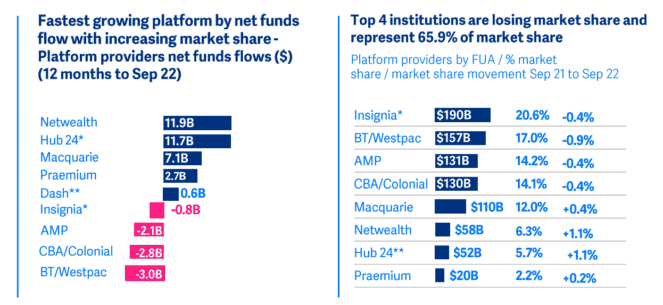
    Netwealth brings wealth management to the twenty-first century with its cloud-based software platform. As its management attests, it is the fastest-growing financial services platform with $11.9 billion of net fund inflows for the 12 months to September 2022.

    In my opinion, the Netwealth team delivered on all key objectives in the first half. Funds under administration (FUA) and funds under management (FUM) grew by 12.2% and 10.4% respectively. In turn, the company was able to increase its total revenue by 18.9% to $102.8 million and deliver a statutory net profit after tax (NPAT) of $30.6 million — up 12.9%.

    Source: Netwealth 1H2023 Results Presentation

    Netwealth is executing its mission to provide a better platform than the big wealth-managing incumbents, as demonstrated by the image above. The company continues to nibble away at the market share of competitors.

    How did investors react to the release? The Netwealth share price finished 2.7% higher on 15 February… hardly a move to write home about. Although the ASX share trades on a price-to-earnings (P/E) ratio of 56 times, I think there is a level of underappreciation for the extent of growth that could still lie ahead for Netwealth.

    DGL Group Ltd (ASX: DGL)

    The next company I believe the market could be sleeping on is chemicals manufacturer, transporter, storer, and processor, DGL Group. Shares in this ASX small-cap share finished flat after the company released its first-half results to the market on 28 February.

    After a string of acquisitions during the half, DGL reported a 52% increase in sales revenue compared to the prior corresponding period. Impressively, the company notched up its earnings before interest, taxes, depreciation, and amortisation (EBITDA) by 35%.

    I have a suspicion that the market may have written off DGL’s growth as purely a byproduct of acquisitions. However, as noted in the presentation, 69% of EBITDA growth was organic. Morgans also highlighted that the result showed an ability to grow organically. The broker currently has a buy rating on the ASX share.

    What I find enticing about this company, that I think others are overlooking, is the moat it is building through its geographic footprint. Its operations are widely spread across Australia and New Zealand through its network of warehouses (see here). Such a network is difficult to replicate without significant capital.

    In my opinion, the expanded network could give DGL an edge in terms of beating competitors on price for transport and product (due to scale) and time for delivery fulfilment (due to proximity).

    Supply Network Limited (ASX: SNL)

    The last ASX share that I think the market snubbed upon the release of its results during the earnings season is Supply Network. This company sells after-market parts primarily for trucks and buses within Australia and New Zealand.

    Simply put, Supply Network’s results were extremely strong. Shares lifted a dismal 0.3% on the day of the company’s reporting. The half-year filing left a bit to be desired in terms of commentary and added details.

    However, the numbers speak to a period of continued demand for parts. In quantifiable terms, revenue increased by 23.6% to $119.2 million, while net profits surged 34.1% to $12.7 million. These figures add to a consistent growth trend over the past five years, as depicted below.

    TradingView Chart

    Furthermore, analysts at Ord Minnet think the outlook is still solid for Supply Network with the broker holding an accumulate rating on the ASX share.

    Personally, I share a similar perspective. Cost pressures could linger for a year or two, nudging the average tenure of truck ownership higher. As a result, replacement parts could be in higher demand.

    Aside from this, the company’s balance sheet is in the strongest position its been in years, opening the door to additional growth avenues.

    The post Underappreciated: 3 ASX shares I believe were the quiet achievers of earnings season appeared first on The Motley Fool Australia.

    FREE Guide for New Investors

    Despite what some people may say – we believe investing in shares doesn’t have to be overwhelming or complicated…

    For over a decade, we’ve been helping everyday Aussies get started on their journey.

    And to help even more people cut through some of the confusion “experts’” seem to want to perpetuate – we’ve created a brand-new “how to” guide.

    Yes, Claim my FREE copy!
    *Returns as of March 1 2023

    (function() {
    function setButtonColorDefaults(param, property, defaultValue) {
    if( !param || !param.includes(‘#’)) {
    var button = document.getElementsByClassName(“pitch-snippet”)[0].getElementsByClassName(“pitch-button”)[0];
    button.style[property] = defaultValue;
    }
    }

    setButtonColorDefaults(“#0095C8”, ‘background’, ‘#5FA85D’);
    setButtonColorDefaults(“#0095C8”, ‘border-color’, ‘#43A24A’);
    setButtonColorDefaults(“#fff”, ‘color’, ‘#fff’);
    })()

    More reading

    Motley Fool contributor Mitchell Lawler has no position in any of the stocks mentioned. The Motley Fool Australia’s parent company Motley Fool Holdings Inc. has positions in and has recommended DGL Group, Netwealth Group, and Supply Network. The Motley Fool Australia has positions in and has recommended Netwealth Group and Supply Network. The Motley Fool Australia has recommended DGL Group. The Motley Fool has a disclosure policy. This article contains general investment advice only (under AFSL 400691). Authorised by Scott Phillips.

    from The Motley Fool Australia https://ift.tt/7jGt5SA

  • ‘Still has legs’: Not too late to buy these 2 stellar ASX 200 shares, says expert

    A woman reaches her arms to the sky as a plane flies overhead at sunset.A woman reaches her arms to the sky as a plane flies overhead at sunset.

    Consumers, businesses and the share market are all, understandably, worried about an economic slowdown after ten consecutive months of interest rate rises.

    But the recent reporting season showed how one industry is defying the odds, with Australians throwing cash at it like it’s going out of fashion.

    Wilsons equity strategist Rob Crookston was impressed.

    “While a number of services businesses performed admirably in 1H23, none have quite measured up to the strength of those leveraged to the rebound in travel,” he said in a memo to clients.

    “[Travel companies] reported exceptional results as the significant pent-up demand following years of restrictions continued to be unleashed by consumers.”

    Travel stocks have done pretty well, but there’s more to come

    Despite many travel shares in the S&P/ASX 200 Index (ASX: XJO) taking off in price the past year, Crookston’s team is convinced the boom will continue this year.

    In fact, he reckons the market still hasn’t fully woken up to how profitable the industry will be.

    “We have been positive on the ‘re-opening thematic’ for some time on the view that the market has underestimated the significant amount of pent-up demand for travel, which has helped keep air passenger volumes elevated, even in the face of elevated prices and the broader consumer slowdown,” said Crookston.

    “The reopening still has legs.”

    The hot demand will last well into the 2024 financial year, according to Crookston, who said consumers were prioritising travel costs over other non-discretionary expenses.

    “China’s recent re-opening from lockdown provides another tailwind for the sector.”

    The best ASX travel shares to buy right now

    As for which specific ASX shares are the best exposures to this trend, Crookston’s team is recommending investors go “overweight” on Qantas Airways Limited (ASX: QAN) and IDP Education Ltd (ASX: IEL).

    The Qantas share price has already rocketed more than 32% over the past 12 months.

    “We still believe Qantas is an attractive investment opportunity, given its discount to US peers, the ongoing strength in travel volumes, its leaner cost base post-pandemic, and the attractive industry structure with Virgin and Qantas operating as an effective duopoly.”

    The Wilson team had its bullish thesis confirmed with Qantas’ first-half results.

    “Qantas guided that travel demand is expected to remain strong into FY24, while group capacity continues to increase strongly and airfares are still elevated.”

    International education placement provider IDP is a recent addition to Wilson’s focus portfolio, according to Crookston.

    The Chinese government’s recent ruling that its students must attend face-to-face classes to have credentials from Australian universities recognised is a major coup for IDP Education.

    “Longer term, IDP Education is exposed to significant secular tailwinds, including the rise of India’s middle class, increased university participation rates and rising international student mobility.”

    The reporting season update showed off some incredible numbers.

    “IDP Education’s 1H23 update demonstrated the ongoing acceleration in student placement volumes which increased +53% vs the prior comparable period.”

    IDP shares are currently trading 6.2% lower than they were a year ago.

    The post ‘Still has legs’: Not too late to buy these 2 stellar ASX 200 shares, says expert appeared first on The Motley Fool Australia.

    Wondering where you should invest $1,000 right now?

    When investing expert Scott Phillips has a stock tip, it can pay to listen. After all, the flagship Motley Fool Share Advisor newsletter he has run for over ten years has provided thousands of paying members with stock picks that have doubled, tripled or even more.*

    Scott just revealed what he believes could be the ‘five best ASX stocks’ for investors to buy right now. These stocks are trading at near dirt-cheap prices and Scott thinks they could be great buys right now…

    See The 5 Stocks
    *Returns as of March 1 2023

    (function() {
    function setButtonColorDefaults(param, property, defaultValue) {
    if( !param || !param.includes(‘#’)) {
    var button = document.getElementsByClassName(“pitch-snippet”)[0].getElementsByClassName(“pitch-button”)[0];
    button.style[property] = defaultValue;
    }
    }

    setButtonColorDefaults(“#0095C8”, ‘background’, ‘#5FA85D’);
    setButtonColorDefaults(“#0095C8”, ‘border-color’, ‘#43A24A’);
    setButtonColorDefaults(“#fff”, ‘color’, ‘#fff’);
    })()

    More reading

    Motley Fool contributor Tony Yoo has no position in any of the stocks mentioned. The Motley Fool Australia’s parent company Motley Fool Holdings Inc. has positions in and has recommended Idp Education. The Motley Fool Australia has recommended Idp Education. The Motley Fool has a disclosure policy. This article contains general investment advice only (under AFSL 400691). Authorised by Scott Phillips.

    from The Motley Fool Australia https://ift.tt/ZpxuUXf

  • 5 things to watch on the ASX 200 on Monday

    An analyst wearing a dark blue shirt and glasses sits at his computer with his chin resting on his hands as he looks at the CBA share price movement today

    An analyst wearing a dark blue shirt and glasses sits at his computer with his chin resting on his hands as he looks at the CBA share price movement today

    On Friday, the S&P/ASX 200 Index (ASX: XJO) finished the week on a very disappointing note. The benchmark index sank 2.3% to 7,144.7 points.

    Will the market be able to bounce back from this on Monday? Here are five things to watch:

    ASX 200 expected to fall again

    The Australian share market looks set to start the week in the red following a poor finish to the last one on Wall Street. According to the latest SPI futures, the ASX 200 is expected to open the day 39 points or 0.55% lower this morning. On Wall Street, the Dow Jones was down 1.1%, the S&P 500 fell 1.45%, and the NASDAQ dropped 1.8%.

    Oil prices rise

    ASX 200 energy shares including Santos Ltd (ASX: STO) and Beach Energy Ltd (ASX: BPT) could have a decent start to the week after oil prices rose on Friday. According to Bloomberg, the WTI crude oil price was up 1.3% to US$76.68 a barrel and the Brent crude oil price rose 1.45% to US$82.78 a barrel. A solid US payrolls update gave prices a boost.

    Bank shares on watch

    Bendigo and Adelaide Bank Ltd (ASX: BEN), Commonwealth Bank of Australia (ASX: CBA), and other ASX 200 banks will be on watch today after a bank run led to the collapse of Silicon Valley Bank (SVB) on Friday. In addition, investors will be waiting to hear if any ASX 200 tech stocks had any cash held in one of the US bank’s uninsured savings accounts.

    Gold price charges higher

    Gold miners Evolution Mining Ltd (ASX: EVN) and Northern Star Resources Ltd (ASX: NST) could have a great start to the week after the gold price stormed higher on Friday night. According to CNBC, the spot gold price rose 1.8% to $1,867.20 per ounce. Strong demand for safe haven assets boosted the precious metal.

    Core Lithium shares remain a sell

    The Core Lithium Ltd (ASX: CXO) share price remains overvalued despite recent weakness. That’s the view of analysts at Goldman Sachs, who have reiterated their sell rating and 90 cents price target. Goldman has been looking at the lithium market and nots continued weakness in spot prices.

    The post 5 things to watch on the ASX 200 on Monday appeared first on The Motley Fool Australia.

    Wondering where you should invest $1,000 right now?

    When investing expert Scott Phillips has a stock tip, it can pay to listen. After all, the flagship Motley Fool Share Advisor newsletter he has run for over ten years has provided thousands of paying members with stock picks that have doubled, tripled or even more.*

    Scott just revealed what he believes could be the ‘five best ASX stocks’ for investors to buy right now. These stocks are trading at near dirt-cheap prices and Scott thinks they could be great buys right now…

    See The 5 Stocks
    *Returns as of March 1 2023

    (function() {
    function setButtonColorDefaults(param, property, defaultValue) {
    if( !param || !param.includes(‘#’)) {
    var button = document.getElementsByClassName(“pitch-snippet”)[0].getElementsByClassName(“pitch-button”)[0];
    button.style[property] = defaultValue;
    }
    }

    setButtonColorDefaults(“#43B02A”, ‘background’, ‘#5FA85D’);
    setButtonColorDefaults(“#43B02A”, ‘border-color’, ‘#43A24A’);
    setButtonColorDefaults(“#fff”, ‘color’, ‘#fff’);
    })()

    More reading

    Motley Fool contributor James Mickleboro has no position in any of the stocks mentioned. The Motley Fool Australia’s parent company Motley Fool Holdings Inc. has no position in any of the stocks mentioned. The Motley Fool Australia has positions in and has recommended Bendigo And Adelaide Bank. The Motley Fool has a disclosure policy. This article contains general investment advice only (under AFSL 400691). Authorised by Scott Phillips.

    from The Motley Fool Australia https://ift.tt/JiTB72Y

  • Big lesson from reporting season: STAY AWAY from these ASX shares, says expert

    A man looks at his laptop waiting in anticipation.A man looks at his laptop waiting in anticipation.

    Last month’s ASX reporting season was “a mixed bag” — but one massive trend was clear to everyone.

    That’s according to Wilsons equity strategist Rob Crookston, who is in no doubt that ten consecutive months of interest rate rises is causing immense pain for Australians.

    “Reporting season provided further evidence that consumers are paring back their expenditure on discretionary goods and big-ticket items, as pulled-forward demand from COVID unwinds and cost of living pressures eat into household budgets,” he said in a memo to clients.

    Crookston noted how sales have fallen for many retailers, compared to a year earlier.

    This is starting to cause a pile-up in warehouses, which can trigger multiple negative effects.

    “The moderating consumer demand backdrop has driven a rise in inventory levels for some names,” he said.

    “Not only is sitting on elevated inventories often a forward indicator of softening demand, it can also create additional costs (e.g. warehousing) while it weighs on free cash flows and increases the risk of product obsolescence, which can necessitate an increase in promotional activity to clear stock.”

    The tightening of wallets is even impacting businesses that sell essential goods.

    “There has also been increasing commentary that consumers are ‘trading down’, with Woolworths Group Ltd (ASX: WOW) CEO Brad Banducci saying consumers were eating more at home rather than dining out, for example.”

    The stocks to avoid and one to buy right now

    So what does this mean for ASX share investors?

    The most straightforward tip from Crookston is to avoid buying into the sectors that are directly hurt by a decline in shoppers.

    “The focus portfolio has no exposure to the retail or consumer goods sectors, which we think are close to peak (cyclical) earnings.”

    However, there is an opportunity to buy ASX shares of businesses that provide consumer services.

    These companies are “continuing to benefit from the shift of spending from goods to services and have attractive long-term earnings growth potential”. 

    Crookston’s top buy in this category is Lottery Corporation Ltd (ASX: TLC), which boasts “predictable, infrastructure-like cash flows that are underpinned by its long-dated licences”.

    “The Lottery Corporation had a stellar 1H23 result, which included EBITDA growth of +15.8% as lottery sales were resilient,” he said.

    “At the same time, margins benefitted from an increasing penetration of the digital channel.”

    The great tailwind for the company is the “defensive nature of lottery demand”, which has shown resilience in the past through tough economic conditions.

    The post Big lesson from reporting season: STAY AWAY from these ASX shares, says expert appeared first on The Motley Fool Australia.

    Tech Stock That’s Changing Streaming

    Streaming TV Shocker: One stock we think could be set to profit as people ditch free-to-air for streaming TV (Hint It’s not Netflix, Disney+, or even Amazon Prime.)

    Learn more about our Tripledown report
    *Returns as of March 1 2023

    (function() {
    function setButtonColorDefaults(param, property, defaultValue) {
    if( !param || !param.includes(‘#’)) {
    var button = document.getElementsByClassName(“pitch-snippet”)[0].getElementsByClassName(“pitch-button”)[0];
    button.style[property] = defaultValue;
    }
    }

    setButtonColorDefaults(“#0095C8”, ‘background’, ‘#5FA85D’);
    setButtonColorDefaults(“#0095C8”, ‘border-color’, ‘#43A24A’);
    setButtonColorDefaults(“#fff”, ‘color’, ‘#fff’);
    })()

    More reading

    Motley Fool contributor Tony Yoo has no position in any of the stocks mentioned. The Motley Fool Australia’s parent company Motley Fool Holdings Inc. has no position in any of the stocks mentioned. The Motley Fool Australia has no position in any of the stocks mentioned. The Motley Fool has a disclosure policy. This article contains general investment advice only (under AFSL 400691). Authorised by Scott Phillips.

    from The Motley Fool Australia https://ift.tt/aozBdy1