• Never buy the dip if you see these red flags

    This article was originally published on Fool.com. All figures quoted in US dollars unless otherwise stated.

    peloton shares represented by man syncing smart watch with computer app

    This article was originally published on Fool.com. All figures quoted in US dollars unless otherwise stated.

    After you’ve been investing for a while, you begin to see the bright side of share-price declines, because they often present opportunities to buy great companies at discounted prices.

    Not every beaten-down stock is a good investment, though. Sometimes, stocks fall for good reason, and buying them after a significant crash is actually a value trap instead of a bargain opportunity.

    To avoid catching falling knives, you have to be able to distinguish the quality companies the market is overlooking from the struggling businesses that will likely continue to face challenges. To that end, I never invest in beaten-down companies if I see these two red flags:

    1. The company will likely need to raise more money to fund operations.
    2. The business is facing secular headwinds.

    Let’s unpack these two concepts by looking at an example: Peloton Interactive (NASDAQ: PTON).

    Avoid zombies like the plague

    A zombie company is a business that is on a path toward insolvency unless it manages to raise additional capital, either in the form of an additional equity offering (selling more stock) or by taking on new debt.

    These companies are completely dependent on new capital injections to survive, and when interest rates start to rise and the market becomes more averse to risk, they’re often forced to take on new debt at very unfavorable interest rates, exacerbating their balance sheets woes.

    Peloton has certainly struggled in the last year with demand dropping off a cliff and operating expenses rising.

    This led Dave Trainer, the CEO of the research firm New Constructs, to say the following in a recent publication: “Peloton’s issues are well telegraphed — given the stock’s decline over the past year — but investors may not realize that the company only has a few months’ worth of cash remaining to fund its operations, which puts the stock in danger of falling to $0 per share.”

    Trainer’s harsh comments are substantiated when you look at the company’s shrinking cash position:

    MetricJune 30, 2020June 30, 2021March 21, 2022
    Cash*$1.75 billion$1.60 billion$879 million

    Data source: Peloton earnings reports. *Includes cash equivalents and short-term investments.

    The interactive fitness specialist is also burning cash at an accelerated rate, going from free-cash-flow positive in 2020 to reporting negative free cash flow for five straight quarters. And the fiscal third quarter saw the biggest outflow yet of $746.7 million.

    While Peloton’s newly appointed CEO, Barry McCarthy, is hoping to pull off the comeback of the decade, Peloton is a company that may soon be raising capital in an environment where doing so is no longer cheap.

    Pass on businesses operating in declining markets

    Another major red flag is when a company operates in an industry with major secular headwinds. Peloton had a tremendous first-mover advantage which it cashed in during the pandemic as the connected-fitness industry enjoyed a surge in popularity. But as things have started returning to normal, the at-home fitness sector has experienced a complete reversal with waning demand, which is visible in Peloton’s rapidly slowing revenue growth.

    MetricQ3 2021Q4 2021Q1 2022Q2 2022Q3 2022
    Revenue growth141%54%6%6%(15%)

    Data source: Peloton earnings reports.

    And Peloton is not alone. Rival fitness brand Nautilus recently announced a 70% decline in sales in the most recent quarter, while the parent company of NordicTrack scrapped its plans to go public this year among various rounds of layoffs.

    The at-home fitness equipment industry may eventually live up to the hype, but for the foreseeable future, it faces an uphill battle as fitness enthusiasts elect to return to gyms and outdoor activities.

    Buy the dip, but do it intelligently

    I’m a huge proponent of buying beaten-down stocks as long as they’re high-quality companies. And to determine that, you need to be on the lookout for red flags.

    As you can see with Peloton, the potential need to raise capital to fund operations (especially when interest rates are rising) and major industry headwinds are two indications the stock could be a falling knife instead of a diamond in the rough.

    This article was originally published on Fool.com. All figures quoted in US dollars unless otherwise stated.

    The post Never buy the dip if you see these red flags appeared first on The Motley Fool Australia.

    Should you invest $1,000 in Peloton Interactive right now?

    Before you consider Peloton Interactive, you’ll want to hear this. Motley Fool Investing expert Scott Phillips just revealed what he believes are the 5 best stocks for investors to buy right now… and Peloton Interactive wasn’t one of them. The online investing service he’s run for over a decade, Motley Fool Share Advisor, has provided thousands of paying members with stock picks that have doubled, tripled or even more.* And right now, Scott thinks there are 5 stocks that are better buys.

    See The 5 Stocks *Returns as of August 4 2022

    (function() { function setButtonColorDefaults(param, property, defaultValue) { if( !param || !param.includes(‘#’)) { var button = document.getElementsByClassName(“pitch-snippet”)[0].getElementsByClassName(“pitch-button”)[0]; button.style[property] = defaultValue; } } setButtonColorDefaults(“#0095C8”, ‘background’, ‘#5FA85D’); setButtonColorDefaults(“#0095C8”, ‘border-color’, ‘#43A24A’); setButtonColorDefaults(“#fff”, ‘color’, ‘#fff’); })()

    More reading

    Mark Blank has no position in any of the stocks mentioned. The Motley Fool Australia’s parent company Motley Fool Holdings Inc. has positions in and has recommended Peloton Interactive. The Motley Fool Australia has no position in any of the stocks mentioned. The Motley Fool has a disclosure policy. This article contains general investment advice only (under AFSL 400691). Authorised by Scott Phillips.

    This article was originally published on Fool.com. All figures quoted in US dollars unless otherwise stated.


    from The Motley Fool Australia https://ift.tt/5b1JpCF

  • Why is the Magellan share price slumping 10% today?

    Young male with glasses holding book in front of his face with a surprised expression, indicating a share price movement.Young male with glasses holding book in front of his face with a surprised expression, indicating a share price movement.

    The Magellan Financial Group Ltd (ASX: MFG) share price has sunk 10.4% in morning trading. That compares to a drop of 0.88% for the S&P/ASX 200 Index (ASX: XJO).

    What’s going on with the fund manager? It has today given up all of the gains it experienced over the past month.

    It may be important to remember there are a number of different things that can cause a share price to fall. Wider market negativity could cause some investors to sell shares. A decline could occur due to a negative update from the company. There’s also the potential for a business to fall when it goes ex-dividend, particularly when the dividend yield is large.

    Magellan goes ex-dividend

    The fund manager’s board of directors declared a dividend of 68.9 cents per share for the six months to 30 June 2022, bringing total dividends for FY22 to $1.79 per share.

    This dividend declaration came after a 3% fall in adjusted net profit after tax (NPAT) to $399.7 million and an 11% fall in profit before tax and performance fees of its funds management segment to $470.6 million.

    Investors who buy shares from today onwards will no longer be entitled to the recently declared dividend of 68.9 cents per share.

    As our ex-dividend explainer page points out, the ex-dividend can cause movement in a share price, as we’ve seen today with the Magellan share price:

    A company’s share price may increase in the lead-up to its ex-dividend date, as new investors may be willing to pay a premium to receive the dividend payment. Conversely, once the ex-dividend date has arrived, the share price may fall because the right to the dividend payment is no longer attached to purchases. Investors who purchased additional shares simply to receive the dividend may sell some or all of their shares, pushing the share price down.

    With the Magellan share price down more than the dividend payment, that may explain some of what’s happening. Keep in mind that the ASX 200 is also down 0.88% right now, so that may explain some of the larger-than-expected fall.

    How does Magellan decide on its dividends?

    Magellan has a dividend policy, subject to corporate legal and regulatory considerations.

    It pays out interim and final dividends based on 90% to 95% of its net profit after tax of its funds management business, excluding crystallised performance fees.

    Magellan also pays an annual performance fee dividend of 90% to 95% of its net crystallised performance fees after tax.

    Magellan share price snapshot

    The Magellan share price is down almost 40% in 2022.

    The post Why is the Magellan share price slumping 10% today? appeared first on The Motley Fool Australia.

    Wondering where you should invest $1,000 right now?

    When investing expert Scott Phillips has a stock tip, it can pay to listen. After all, the flagship Motley Fool Share Advisor newsletter he has run for over ten years has provided thousands of paying members with stock picks that have doubled, tripled or even more.* Scott just revealed what he believes could be the “five best ASX stocks” for investors to buy right now. These stocks are trading at near dirt-cheap prices and Scott thinks they could be great buys right now

    See The 5 Stocks
    *Returns as of August 4 2022

    (function() {
    function setButtonColorDefaults(param, property, defaultValue) {
    if( !param || !param.includes(‘#’)) {
    var button = document.getElementsByClassName(“pitch-snippet”)[0].getElementsByClassName(“pitch-button”)[0];
    button.style[property] = defaultValue;
    }
    }

    setButtonColorDefaults(“#43B02A”, ‘background’, ‘#5FA85D’);
    setButtonColorDefaults(“#43B02A”, ‘border-color’, ‘#43A24A’);
    setButtonColorDefaults(“#fff”, ‘color’, ‘#fff’);
    })()

    More reading

    Motley Fool contributor Tristan Harrison has no position in any of the stocks mentioned. The Motley Fool Australia’s parent company Motley Fool Holdings Inc. has no position in any of the stocks mentioned. The Motley Fool Australia has no position in any of the stocks mentioned. The Motley Fool has a disclosure policy. This article contains general investment advice only (under AFSL 400691). Authorised by Scott Phillips.

    from The Motley Fool Australia https://ift.tt/ZdRVfG7

  • Cooper Energy share price spikes following FY22 results and update

    Oil miner holding a laptop and mobile phone looks at his phone and sees the falling oil price and falling Woodside share priceOil miner holding a laptop and mobile phone looks at his phone and sees the falling oil price and falling Woodside share price

    The Cooper Energy Ltd (ASX: COE) share price is trading 3% higher on Monday following the release of its financial results for the 12 months ended 30 June 2022.

    At the time of writing, the share is fetching 23.3 cents apiece, down from its 52-week closing high of 59 cents in January.

    Cooper Energy share price lifts on FY22 results

    Key takeouts from the period include:

    • Revenue up 56% year on year to $205.4 million
    • Underlying EBITDA (excluding exploration) also gained 169% from the previous year to $80.7 million
    • Underlying net profit after tax of $14.4 million, up from a $25.9 million loss in FY21
    • Balance sheet with more liquidity after $244 million equity raise and new $420 million debt facility established
    • Guidance of 50% EBITDA growth “at the lower end” before exploration costs

    What else happened during this period for Cooper Energy?

    It was a year of records for Cooper Energy, with the company scoring its largest year of production, revenue, EBITDA and underlying profit.

    Full-year production came into 3.31 million barrels of oil equivalent (MMboe), whereas revenue was up 56% year on year.

    It also saw a large swing in NPAT from a $26 million loss in FY21 to a $14 million return to the black this year.

    Cooper Energy also made the claim to be Australia’s “first net zero gas and oil producer”, in its announcement.

    Management commentary

    Speaking on the announcement, Cooper Energy managing director, David Maxwell said:

    [T]he business imperatives achieved in FY22, and the supply of increasing gas volumes to the Australian East Coast domestic gas market, underpin the significant contrast to where the business was 12 months ago.

    FY22 was a transformative year for Cooper Energy. We are positioned as a competitive integrated
    business operating our two integrated gas hubs, with the commensurate step change in cash generation for future growth.

    What’s next for Cooper Energy?

    The company is forecasting a 12–21% increase in production for FY23, calling for 3.7–4MMBoe in the 12 months.

    This calls for an underlying EBITDA of $120–$180 million, a gain of 49–86%, whereas capital expenditures are projected to land between $28–$33 million.

    In the past 12 months, the Cooper Energy share price has gained 20%.

    The post Cooper Energy share price spikes following FY22 results and update appeared first on The Motley Fool Australia.

    Wondering where you should invest $1,000 right now?

    When investing expert Scott Phillips has a stock tip, it can pay to listen. After all, the flagship Motley Fool Share Advisor newsletter he has run for over ten years has provided thousands of paying members with stock picks that have doubled, tripled or even more.* Scott just revealed what he believes could be the “five best ASX stocks” for investors to buy right now. These stocks are trading at near dirt-cheap prices and Scott thinks they could be great buys right now

    See The 5 Stocks
    *Returns as of August 4 2022

    (function() {
    function setButtonColorDefaults(param, property, defaultValue) {
    if( !param || !param.includes(‘#’)) {
    var button = document.getElementsByClassName(“pitch-snippet”)[0].getElementsByClassName(“pitch-button”)[0];
    button.style[property] = defaultValue;
    }
    }

    setButtonColorDefaults(“#0095C8”, ‘background’, ‘#5FA85D’);
    setButtonColorDefaults(“#0095C8”, ‘border-color’, ‘#43A24A’);
    setButtonColorDefaults(“#fff”, ‘color’, ‘#fff’);
    })()

    More reading

    Motley Fool contributor Zach Bristow has no position in any of the stocks mentioned. The Motley Fool Australia’s parent company Motley Fool Holdings Inc. has no position in any of the stocks mentioned. The Motley Fool Australia has no position in any of the stocks mentioned. The Motley Fool has a disclosure policy. This article contains general investment advice only (under AFSL 400691). Authorised by Scott Phillips.

    from The Motley Fool Australia https://ift.tt/qKHJ1B5

  • Adairs share price sinks 4% despite record full-year sales

    Man's legs poking out of a brown sofa while his body is sinking down into the back of it, dog looking onMan's legs poking out of a brown sofa while his body is sinking down into the back of it, dog looking on

    The Adairs Ltd (ASX: ADH) share price is slipping after the homewares retailer released its earnings for financial year 2022.

    The stock has continued to dive after opening 2.35% lower at $2.49. The Adairs share price is currently trading at $2.44, marking a 4.31% fall.

    Adairs share price slumps despite 13% lift in sales

    Here are the key takeaways from the retailer’s full-year earnings:

    • Sales revenue lifted 12.9% on that of the prior comparable period (pcp) to a record $564.5 million
    • Net profit after tax (NPAT) fell 29.6% to $44.9 million
    • Underlying earnings before interest and tax (EBIT) tumbled 30% to $76.4 million
    • Online sales made up around 35% of sales, or $195.4 million worth – 4.5% more than in the pcp
    • Ended the period with a net debt position of $93.2 million
    • Posted a 10 cent per share final dividend, bringing its full-year payout to 18 cents

    Adairs battled COVID-19-induced store closures over FY22, losing around 16% of trading days in the first half. However, the newly acquired Focus on Furniture and its Mocha brand bolstered the company’s bottom line.

    Adairs’ core retail business saw sales fall 4.8% to $418.7 million over the 12 months ended 26 June, while those of Mocha lifted 6.5% to $64.1 million despite a disappointing second half. Focus on Furniture brought in $81.7 million over the seven months in which Adairs owned the brand.

    The company’s gross margin also slipped to 63.2% due to higher supply chain costs and greater promotional activity, born from a more competitive market.

    Adairs boasted one million paying Linen Lover loyalty members, who accounted for 80% of sales, at the end of the fiscal year.

    What else happened in FY22?

    Of course, the major news from the retailer over the financial year 2022 was its acquisition of Focus on Furniture.

    The acquisition valued the bulky furniture business at $80 million. The Adairs share price lifted 4% on its announcement.

    The company also finalised its earn-out agreement with the founders of Mocka in the period.

    What did management say?

    Adairs managing director and CEO Mark Ronan commented on the company’s earnings, saying:

    Financial year 2022 produced another record level of sales following the acquisition of Focus. This comes despite widespread store closures due to COVID and reflects the strength of our omni-channel model.

    Significant operational disruptions related to COVID-19 … impacted the group’s cost base and meant that this growth did not translate into an increase in profits.

    The majority of these costs are not expected to carry into future years and while a number of macroeconomic headwinds have emerged in recent months, we are confident that this tougher environment will favour companies such as Adairs, Mocka, and Focus all of whom provide a strong value proposition to the large and growing middle-market consumer.

    What’s next?

    Excitingly, Adairs believes its sales growth will continue in financial year 2023.

    The company expects to post between $625 million and $665 million of sales revenue this fiscal year. That represents a potential 17.8% year-on-year increase. It also expects $75 million to $85 million of EBIT and $12 million to $15 million of capital investment.

    The company also provided a trading update for the first seven weeks of FY23.

    Its unaudited sales lifted 44.8% over the period compared to the pcp. When excluding sales from Focus on Furniture, it boasted a 3.9% increase.

    Adairs share price snapshot

    The Adairs share price has had a rough trot as of late.

    It’s fallen nearly 39% since the start of 2022 and is currently 33% lower than it was this time last year.

    For comparison, the All Ordinaries Index (ASX: XAO) has slipped 8% year to date and 6% over the last 12 months.

    The post Adairs share price sinks 4% despite record full-year sales appeared first on The Motley Fool Australia.

    Wondering where you should invest $1,000 right now?

    When investing expert Scott Phillips has a stock tip, it can pay to listen. After all, the flagship Motley Fool Share Advisor newsletter he has run for over ten years has provided thousands of paying members with stock picks that have doubled, tripled or even more.* Scott just revealed what he believes could be the “five best ASX stocks” for investors to buy right now. These stocks are trading at near dirt-cheap prices and Scott thinks they could be great buys right now

    See The 5 Stocks
    *Returns as of August 4 2022

    (function() {
    function setButtonColorDefaults(param, property, defaultValue) {
    if( !param || !param.includes(‘#’)) {
    var button = document.getElementsByClassName(“pitch-snippet”)[0].getElementsByClassName(“pitch-button”)[0];
    button.style[property] = defaultValue;
    }
    }

    setButtonColorDefaults(“#0095C8”, ‘background’, ‘#5FA85D’);
    setButtonColorDefaults(“#0095C8”, ‘border-color’, ‘#43A24A’);
    setButtonColorDefaults(“#fff”, ‘color’, ‘#fff’);
    })()

    More reading

    Motley Fool contributor Brooke Cooper has no position in any of the stocks mentioned. The Motley Fool Australia’s parent company Motley Fool Holdings Inc. has positions in and has recommended ADAIRS FPO. The Motley Fool Australia has positions in and has recommended ADAIRS FPO. The Motley Fool has a disclosure policy. This article contains general investment advice only (under AFSL 400691). Authorised by Scott Phillips.

    from The Motley Fool Australia https://ift.tt/V5jzdoZ

  • oOh! Media Ltd share price jumps 9% on big earnings increase

    A young man wearing glasses and a denim shirt sits at his desk and raises his fists and screams with delight as he watches the ResApp share price go 50% higher todayA young man wearing glasses and a denim shirt sits at his desk and raises his fists and screams with delight as he watches the ResApp share price go 50% higher today

    The oOh Media Ltd (ASX: OML) share price is shooting higher in Monday morning trading amid the release of the company’s optimistic first-half results for FY22.

    Shares of the outdoor advertising and media company currently trade for $1.347 each, an 9.07% gain on their previous closing price.

    Let’s go over the highlights from the company’s report.

    What did oOh! Media Report?

    oOh! Media’s said its results were buoyed by increased investment in its Out of Home media format.

    The end of COVID-19 lockdowns and falling case numbers also appear to have positively influenced the company’s fundamentals, with its road, retail, and street furniture advertising sales above 2019 pre-COVID levels.

    The fully franked dividend of 1.5 cents a share has a record date of 1 September with the anticipated payment date of 22 September.

    The company also announced an on-market share buyback of 10% of its issued shares for roughly $75 million. That’s expected to begin next month.

    What else happened in 1H FY22?

    oOh! Media expanded its digital Out of Home business, adding 378 new locations. These included 21 retail centres and 11 road digital advertising platforms.

    The company says it has strengthened its balance sheet by reducing net debt, which fell to $39.8 million in June 2022 from $63.5 million on December 21.

    oOh! Media also launched Poly, described as a “creative and content innovation hub”. The company says this helps its advertisers expand their reach and increase the return on investment from their advertising spend.

    What did management say?

    oOh! Media Chief Executive Officer Cathy O’Connor said:

    Our strategy remains clear and consistent. As the market leader across Australia/New Zealand, we are exceptionally well placed to capitalise on the growth of Out Of Home as advertisers increase their investment into this media format. We continue to participate in the emerging programmatic digital Out of Home marketplace with our programmatic revenue more than doubling in the second quarter of CY22 compared to the first quarter.

    What’s next?

    For the third quarter of FY22 and beyond, the company stated its fundamentals remain “compelling” and that it is positioned to derive growth from its Out of Home revenue stream.

    Revenue was said to be 37% higher than the same quarter in CY21, while capital expenditure is expected to increase significantly.

    Capital expenditure will be between $25 million to $35 million, an increase from $15 million in CY21. Reasons for the increase were to accelerate revenue growth and for concession renewals.

    oOh! Media share price snapshot

    The oOh! Media share price is currently down 21% in 2022 so far. That’s significantly below the performance of the S&P/ASX 200 Index (ASX: XJO) which has lost around 5.5% over the same period.

    oOh! Media has a market capitalisation of around $802 million including today’s recent price action.

    The post oOh! Media Ltd share price jumps 9% on big earnings increase appeared first on The Motley Fool Australia.

    Wondering where you should invest $1,000 right now?

    When investing expert Scott Phillips has a stock tip, it can pay to listen. After all, the flagship Motley Fool Share Advisor newsletter he has run for over ten years has provided thousands of paying members with stock picks that have doubled, tripled or even more.* Scott just revealed what he believes could be the “five best ASX stocks” for investors to buy right now. These stocks are trading at near dirt-cheap prices and Scott thinks they could be great buys right now

    See The 5 Stocks
    *Returns as of August 4 2022

    (function() {
    function setButtonColorDefaults(param, property, defaultValue) {
    if( !param || !param.includes(‘#’)) {
    var button = document.getElementsByClassName(“pitch-snippet”)[0].getElementsByClassName(“pitch-button”)[0];
    button.style[property] = defaultValue;
    }
    }

    setButtonColorDefaults(“#43B02A”, ‘background’, ‘#5FA85D’);
    setButtonColorDefaults(“#43B02A”, ‘border-color’, ‘#43A24A’);
    setButtonColorDefaults(“#fff”, ‘color’, ‘#fff’);
    })()

    More reading

    Motley Fool contributor Matthew Farley has no position in any of the stocks mentioned. The Motley Fool Australia’s parent company Motley Fool Holdings Inc. has no position in any of the stocks mentioned. The Motley Fool Australia has recommended oOh!Media Ltd. The Motley Fool has a disclosure policy. This article contains general investment advice only (under AFSL 400691). Authorised by Scott Phillips.

    from The Motley Fool Australia https://ift.tt/6SsrlCQ

  • EML share price leaps 11% on results and share buyback

    A man reacts with surprise when her see a bargain price on his phone.A man reacts with surprise when her see a bargain price on his phone.

    The EML Payments Ltd (ASX: EML) share price is surging higher from the open today following the release of its FY22 results and annual report. At the time of writing, EML is trading up 10.85% at $1.175.

    EML also announced an on-market buyback program of up to $20 million after it entered into a sale agreement for the investment in Interchecks Technologies, Inc.

    EML share price lunges forward on FY22 results

    Key takeouts from the period include:

    • Record revenue of $234.1 million, up 21% on prior corresponding period (PCP)
    • Gross debit volume of $80.2 billion, up 308% on PCP and a record
    • Gross profit margin of 68%, up 1% on the year prior
    • Underlying EBITDA of $51.2 million, a decrease of 4% on PCP
    • Group Underlying net profit after tax (NPAT) of $32.1 million, down 1% from last year’s result
    • Announced $20 million buyback program

    What else happened last period for EML?

    Whilst it was a strong period of growth in revenue and gross debit volume for the company, it wasn’t as rosy further down the income statement.

    The group’s earnings before interest, tax, depreciation and amortisation (EBITDA) and NPAT both contracted in the single digits respectively.

    This is important, as EML explains that EBITDA “is used as the most appropriate measure of assessing the performance of the group.”

    EML also booked $23.5 million in account maintenance fees for European accounts that have been active for greater than 12 months.

    Underlying overheads also widened by 41% to $108 million, up from $77 million the year prior.

    As a result, this performance underlines a strategic review that’s set to be be driven by EML’s newly
    appointed CEO, Emma Shand, the release says.

    Management commentary

    Speaking on the announcement, Shand said:

    My early conversations with key stakeholders have been very constructive and helpful in shaping my immediate focus. It validates to me that whilst we have a strong base it is time for a proactive strategic review of all aspects of the business.

    From what I have already learned, I am highly enthusiastic about EML’s growth and value potential. However, we won’t successfully deliver improved value of those opportunities for our shareholders, if we don’t take a good hard look at how best to set our operating structure and align our capabilities, systems and processes to execute effectively for growth.

    We have already taken some early steps to improve operating focus, elevate a culture of regulatory compliance to support sustainable growth and in optimising balance sheet strength.

    The EML share price is down nearly 70% over the past 12 months. 

    The post EML share price leaps 11% on results and share buyback appeared first on The Motley Fool Australia.

    Should you invest $1,000 in Eml Payments Ltd right now?

    Before you consider Eml Payments Ltd, you’ll want to hear this.

    Motley Fool Investing expert Scott Phillips just revealed what he believes are the 5 best stocks for investors to buy right now… and Eml Payments Ltd wasn’t one of them.

    The online investing service he’s run for over a decade, Motley Fool Share Advisor, has provided thousands of paying members with stock picks that have doubled, tripled or even more.* And right now, Scott thinks there are 5 stocks that are better buys.

    See The 5 Stocks
    *Returns as of August 4 2022

    (function() {
    function setButtonColorDefaults(param, property, defaultValue) {
    if( !param || !param.includes(‘#’)) {
    var button = document.getElementsByClassName(“pitch-snippet”)[0].getElementsByClassName(“pitch-button”)[0];
    button.style[property] = defaultValue;
    }
    }

    setButtonColorDefaults(“#43B02A”, ‘background’, ‘#5FA85D’);
    setButtonColorDefaults(“#43B02A”, ‘border-color’, ‘#43A24A’);
    setButtonColorDefaults(“#fff”, ‘color’, ‘#fff’);
    })()

    More reading

    Motley Fool contributor Zach Bristow has no position in any of the stocks mentioned. The Motley Fool Australia’s parent company Motley Fool Holdings Inc. has positions in and has recommended EML Payments. The Motley Fool Australia has positions in and has recommended EML Payments. The Motley Fool has a disclosure policy. This article contains general investment advice only (under AFSL 400691). Authorised by Scott Phillips.

    from The Motley Fool Australia https://ift.tt/XVpQWur

  • Why is the Santos share price in the red on Monday?

    A boy bounces off a big red inflatable slide with a smile on his face.A boy bounces off a big red inflatable slide with a smile on his face.

    The Aussie share market is retreating today after Wall Street recorded substantial losses across the board on Friday.

    The S&P/ASX 200 Index (ASX: XJO) is shedding 1% to 7,045.5 points in morning trade.

    Also in reverse is the Santos Ltd (ASX: STO) share price.

    At the time of writing, the energy producer’s shares are down 1.06% to $7.44.

    Why are Santos shares slipping today?

    Following the release of the company’s half-year results last week, investors are eyeing Santos shares as they go ex-dividend today.

    This means if you purchased the company’s shares last Friday or before and still own them, you will be eligible for the latest dividend.

    When a company reaches its ex-dividend day, its shares tend to fall in proportion to the dividend paid out. This is because investors try to make a quick profit after securing the dividend.

    For those eligible for Santos’ interim dividend, shareholders will receive a payment of US 7.6 cents per share on 22 September. Based on the current USD:AUD exchange rate, this equates to roughly 10.8 Australian cents apiece.

    Furthermore, the interim dividend reflects an increase of 38% compared to the prior corresponding period (US 5.5 cents per share).

    The dividend is also unfranked.

    Under the company’s capital management framework, Santos aims to return US$605 million to shareholders through the interim dividend and an on-market share buyback. The latter received a bump from the US$250 million announced in April 2022 to US$350 million currently.

    Is Santos a buy?

    Following the energy producer’s scorecard for the 2022 half-year results, analysts at Macquarie weighed in on Santos shares.

    According to ANZ Share Investing, the broker raised its 12-month price target by 4% to $10.40. Based on the current Santos share price, this implies an upside of 40%.

    On the other hand, Citi and UBS cut their rating by 3.5% to $8.30, and 2.1% to $9.45, respectively.

    Santos share price snapshot

    Since the beginning of 2022, the Santos share price has mostly travelled in circles until accelerating since the company’s results.

    Year to date, Santos shares are up 18%.

    In comparison, the benchmark ASX 200 index is down 5% over the same timeframe.

    Santos has a price-to-earnings (P/E) ratio of 15.47 with a market capitalisation of roughly $25.23 billion.

    The post Why is the Santos share price in the red on Monday? appeared first on The Motley Fool Australia.

    Wondering where you should invest $1,000 right now?

    When investing expert Scott Phillips has a stock tip, it can pay to listen. After all, the flagship Motley Fool Share Advisor newsletter he has run for over ten years has provided thousands of paying members with stock picks that have doubled, tripled or even more.* Scott just revealed what he believes could be the “five best ASX stocks” for investors to buy right now. These stocks are trading at near dirt-cheap prices and Scott thinks they could be great buys right now

    See The 5 Stocks
    *Returns as of August 4 2022

    (function() {
    function setButtonColorDefaults(param, property, defaultValue) {
    if( !param || !param.includes(‘#’)) {
    var button = document.getElementsByClassName(“pitch-snippet”)[0].getElementsByClassName(“pitch-button”)[0];
    button.style[property] = defaultValue;
    }
    }

    setButtonColorDefaults(“#0095C8”, ‘background’, ‘#5FA85D’);
    setButtonColorDefaults(“#0095C8”, ‘border-color’, ‘#43A24A’);
    setButtonColorDefaults(“#fff”, ‘color’, ‘#fff’);
    })()

    More reading

    Citigroup is an advertising partner of The Ascent, a Motley Fool company. Motley Fool contributor Aaron Teboneras has no position in any of the stocks mentioned. The Motley Fool Australia’s parent company Motley Fool Holdings Inc. has no position in any of the stocks mentioned. The Motley Fool Australia has recommended Macquarie Group Limited. The Motley Fool has a disclosure policy. This article contains general investment advice only (under AFSL 400691). Authorised by Scott Phillips.

    from The Motley Fool Australia https://ift.tt/GP3c804

  • Lendlease share price dips as profits and dividends take a hit in FY22

    Two businessmen look out at the city from the top of a tall building.

    Two businessmen look out at the city from the top of a tall building.The Lendlease Group (ASX: LLC) share price is in the red in morning trade.

    Lendlease shares plunged 4.5% at the open to a low of $10.06 before retracing to their current at $10.34, down 0.58%.

    This follows the release of the S&P/ASX 200 Index (ASX: XJO) property and infrastructure group’s full-year results for the 12 months ending 30 June (FY22).

    Profits turn to losses

    Key takeaways from the report include:

    • Statutory loss after tax of $99 million, down from a profit of $222 in FY21
    • Core operating profit after tax of $276 million, a decrease of 27% year on year
    • Record work in progress of $18.4 billion
    • Final dividend of 11 cents per share, partly franked, down from 12 cents per share in FY21

    What else happened during the 2022 financial year?

    Lendlease said the ongoing impacts of COVID hindered its performance over FY22. Despite those headwinds the company reported progress in its organisational reset.

    The changes included simplifying its operating model and refreshing its leadership and the overall structure of the organisation.

    Costs were significantly reduced, exceeding the company’s savings target of $160 million per year. Lendlease also formed some $11 billion of investment partnerships over the year to grow its platform.

    Other key financials included earnings per share (EPS) of 40.1 cents, down from 54.8 cents per share the prior year.

    Full-year dividends came in at 16 cents per share, down from 27 cents in FY21.

    The company noted a big uptick in its performance in the second half of the year, saying it had “solid momentum” heading into FY23. Core profit in H2 came in at $248 million, up from $28 million in H1.

    Gearing of 7.3% is below the company’s target range of 10% to 20%, with total available liquidity of $3.9 billion.

    What did management say?

    Commenting on the results, Lendlease CEO Tony Lombardo said:

    We made significant progress in resetting our company for future growth. We are now a leaner organisation and more agile in responding to our customers. This year, we formed approximately $11 billion of investment partnerships that will underpin strong growth in funds under management while work in progress is at a record $18.4 billion.

    Lendlease CFO Simon Dixon added:

    Maintaining financial strength, reflected in gearing of less than 10%, was a priority for the group as we transitioned through a reset year. This was achieved while deploying an additional $1 billion of development capital during the year.

    What’s next?

    Looking ahead, the Lendlease share price could be in for some continuing headwinds in FY23 from higher inflation and interest rates.

    The company forecasts its return on invested capital for the investments segment to be in the range of 6% to 7.5% for FY23 while forecasting a return on invested capital for the development segment in the range of 4% to 6%.

    Lendlease forecast earnings before interest, taxes and depreciation (EBITDA) margin for its construction segment in the range of 1.5% to 2.5% for FY23. That’s below its target range of 2% to 3% due to ongoing risks from COVID-19 disruptions, supply chain constraints and costs pressures.

    Lendlease expects a material improvement in the outlook for FY24, with a return on invested capital target for its development segment of 10% to 13% and a return on equity target of 8% to 11%.

    Lendlease share price snapshot

    The Lendlease share price is around 5% in 2022, a drop just under the 7% year-to-date loss posted by the ASX 200.

    The post Lendlease share price dips as profits and dividends take a hit in FY22 appeared first on The Motley Fool Australia.

    Should you invest $1,000 in Lendlease Group right now?

    Before you consider Lendlease Group, you’ll want to hear this.

    Motley Fool Investing expert Scott Phillips just revealed what he believes are the 5 best stocks for investors to buy right now… and Lendlease Group wasn’t one of them.

    The online investing service he’s run for over a decade, Motley Fool Share Advisor, has provided thousands of paying members with stock picks that have doubled, tripled or even more.* And right now, Scott thinks there are 5 stocks that are better buys.

    See The 5 Stocks
    *Returns as of August 4 2022

    (function() {
    function setButtonColorDefaults(param, property, defaultValue) {
    if( !param || !param.includes(‘#’)) {
    var button = document.getElementsByClassName(“pitch-snippet”)[0].getElementsByClassName(“pitch-button”)[0];
    button.style[property] = defaultValue;
    }
    }

    setButtonColorDefaults(“#0095C8”, ‘background’, ‘#5FA85D’);
    setButtonColorDefaults(“#0095C8”, ‘border-color’, ‘#43A24A’);
    setButtonColorDefaults(“#fff”, ‘color’, ‘#fff’);
    })()

    More reading

    Motley Fool contributor Bernd Struben has no position in any of the stocks mentioned. The Motley Fool Australia’s parent company Motley Fool Holdings Inc. has no position in any of the stocks mentioned. The Motley Fool Australia has no position in any of the stocks mentioned. The Motley Fool has a disclosure policy. This article contains general investment advice only (under AFSL 400691). Authorised by Scott Phillips.

    from The Motley Fool Australia https://ift.tt/XfPF3aw

  • Nearmap share price jumps 5% on takeover update

    flying asx share price represented by businessman flying through the airflying asx share price represented by businessman flying through the air

    The Nearmap Ltd (ASX: NEA) share price has taken a big step closer to leaving the ASX as its board unanimously backed last week’s takeover offer from Thoma Bravo.

    The board’s decision comes after the bidder undertook its seven-day due diligence where both parties entered into a scheme implementation deed.

    Shares in the aerial mapping ASX tech company jumped 4.8% to $2.06 in early trade. But the Nearmap share price stayed under the $2.10 offer price as hopes of a competing bid faded.

    Why Nearmap’s board is backing the takeover

    Nearmap’s board agreed to the scheme of arrangement after it engaged in a “robust” review process with its financial and legal advisors.

    It has urged shareholders to vote in favour of the scheme in the absence of a better offer. The Nearmap board believes this is an attractive offer as it is at a premium to where the Nearmap share price was trading recently.

    The board also pointed out that the all-cash takeover gave certainty of value to shareholders. The limited set of conditions attached to the deal was also a deciding factor.

    Takeover conditions

    The scheme contains several standard conditions. This includes an independent expert issuing a report that finds the takeover to be in the best interests of shareholders.

    The transaction must also be approved by Australia’s Foreign Investment Review Board and has to be cleared in the United States.

    There are also certain circumstances whereby either the bidder or target has to pay the other a break fee of up to $10.5 million.

    Naturally, Nearmap’s shareholders will have to vote in favour of the scheme, and the local court give its blessing, for the deal to go ahead.

    What did the directors say?

    Nearmap chairman Peter James commented on the takeover bid, saying:

    Nearmap has achieved considerable success to date in Australia and North America and while, in the long-term, there remains potential future growth trajectory, this has to be balanced with the business and market risks that Nearmap shareholders face remaining as a publicly listed independent company.

    In considering the merits of the Thoma Bravo proposal, the Directors have at all times been guided by our overarching responsibility to consider the interests of Nearmap and all of its shareholders. It is our view that the Thoma Bravo Scheme will realise attractive and certain value for shareholders in current markets.

    Next steps

    A scheme booklet containing details of Nearmap’s takeover and an independent expert’s report will be sent to shareholders in October 2022.

    The shareholder meeting to vote on the scheme is expected to be held the month after.

    If everything goes to plan, the scheme is expected to be implemented by late November.

    The post Nearmap share price jumps 5% on takeover update appeared first on The Motley Fool Australia.

    Should you invest $1,000 in Nearmap Ltd right now?

    Before you consider Nearmap Ltd, you’ll want to hear this.

    Motley Fool Investing expert Scott Phillips just revealed what he believes are the 5 best stocks for investors to buy right now… and Nearmap Ltd wasn’t one of them.

    The online investing service he’s run for over a decade, Motley Fool Share Advisor, has provided thousands of paying members with stock picks that have doubled, tripled or even more.* And right now, Scott thinks there are 5 stocks that are better buys.

    See The 5 Stocks
    *Returns as of August 4 2022

    (function() {
    function setButtonColorDefaults(param, property, defaultValue) {
    if( !param || !param.includes(‘#’)) {
    var button = document.getElementsByClassName(“pitch-snippet”)[0].getElementsByClassName(“pitch-button”)[0];
    button.style[property] = defaultValue;
    }
    }

    setButtonColorDefaults(“#43B02A”, ‘background’, ‘#5FA85D’);
    setButtonColorDefaults(“#43B02A”, ‘border-color’, ‘#43A24A’);
    setButtonColorDefaults(“#fff”, ‘color’, ‘#fff’);
    })()

    More reading

    Motley Fool contributor Brendon Lau has positions in Nearmap Ltd. The Motley Fool Australia’s parent company Motley Fool Holdings Inc. has positions in and has recommended Nearmap Ltd. The Motley Fool Australia has positions in and has recommended Nearmap Ltd. The Motley Fool has a disclosure policy. This article contains general investment advice only (under AFSL 400691). Authorised by Scott Phillips.

    from The Motley Fool Australia https://ift.tt/78XoPsb

  • Better buy stock: Alphabet vs. Amazon

    This article was originally published on Fool.com. All figures quoted in US dollars unless otherwise stated.

    Happy man and woman looking at the share price on a tablet.

    This article was originally published on Fool.com. All figures quoted in US dollars unless otherwise stated.

    Alphabet (NASDAQ: GOOG)(NASDAQ: GOOGL) and Amazon (NASDAQ: AMZN) are two of the most influential technology companies in the world. On the heels of turbulence for the market, and growth stocks in particular this year, each company’s valuation is also down significantly from its previous high.

    With these industry leaders potentially on track for big rebounds, investors could wonder which stock looks like the better buy at today’s prices. Read on to see why two Motley Fool contributors have different views on which company will be a better performer for your portfolio.

    The case for Amazon

    Keith Noonan: When it comes to innovation, Amazon has an absolutely incredible track record. The company built an online bookstore into the leading overall online retail platform, and it continues to shape the direction of the e-commerce world. The tech giant also spearheaded the evolution of cloud-infrastructure services with Amazon Web Services, and the technologies it provides are at the heart of the modern internet and the evolution of cloud-based software.

    Amazon also has a fast-growing digital advertising business that has plenty of room for long-term expansion. Because the company controls the leading online-retail marketplace, it has some natural advantages in the ads space, and it’s still in the early stages of leveraging these strengths to build on its position in the category.

    The company is also a leader in smart speakers and voice-based operating systems, and its move to acquire iRobot should bolster its position in the consumer devices category and augment broader strategic initiatives. Between its various products and services for consumers and businesses, Amazon has access to an incredible amount of data, and this should help the company take advantage of opportunities in artificial intelligence and continue mapping out new growth strategies and ways to capitalize on synergies between its businesses.

    Amazon’s cloud segment is highly profitable and continues to grow at an impressive clip, and advancements in automation and robotics could ultimately make its market-leading e-commerce business much more profitable. With big opportunities in its two core businesses, growth potential in other categories, and a penchant for market-defining innovation, Amazon looks like a great buy today.

    The case for Alphabet

    Parkev Tatevosian: The factors that help make Alphabet an excellent stock to buy are that it holds a dominant position in a massive industry and sells at a relatively inexpensive valuation. Indeed, Alphabet is home to Google, the most powerful search engine worldwide. That’s a critically important business to dominate because so many purchase decisions start with an internet search.

    It can partly explain how Alphabet has expanded its revenue from $46 billion in 2012 to $258 billion in 2021. More importantly, it helped boost operating income from $13.8 billion to $78.7 billion in that same time. Businesses with less dominant positions frequently grapple with competitors, which works toward lower profits. Alphabet’s search engine makes money through advertising. Companies pay Alphabet to have their websites listed near the top of search engine queries.

    It’s estimated that advertisers will spend $838 billion globally in 2022, an 8.4% increase from the year before. That massive figure allowed Alphabet to expand beyond its $258 billion revenue in 2021. If it operated in a smaller market, it could approach a ceiling much faster, making an investment less lucrative.

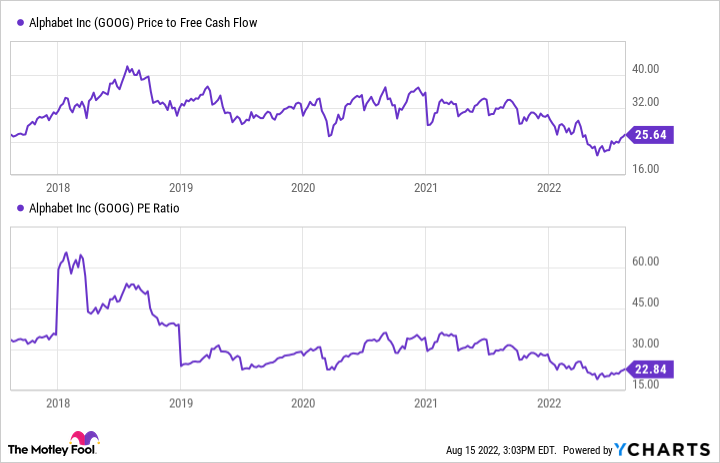
    GOOG Price to Free Cash Flow Chart.

    GOOG Price to Free Cash Flow data by YCharts.

    Despite these excellent prospects, Alphabet is trading relatively inexpensively at a price-to-free-cash-flow ratio of 25.6 and a price-to-earnings ratio of 22.8. These are below its historical averages through the last five years.

    Which big tech stock should you buy today?

    Unless you’re only interested in owning one of these big tech companies in your portfolio, this is a case where buying both stocks could be the right move. Alphabet’s top positions in search, digital advertising, and mobile give it clear avenues to long-term expansion. Meanwhile, Amazon’s market-leading e-commerce and cloud computing businesses give it a strong growth engine, and the company has proven it can successfully branch into new categories. Both of these technology leaders look poised to tap into secular growth trends, and each stock stands a good chance of being a long-term winner.

    This article was originally published on Fool.com. All figures quoted in US dollars unless otherwise stated.

    The post Better buy stock: Alphabet vs. Amazon appeared first on The Motley Fool Australia.

    Wondering where you should invest $1,000 right now?

    When investing expert Scott Phillips has a stock tip, it can pay to listen. After all, the flagship Motley Fool Share Advisor newsletter he has run for over ten years has provided thousands of paying members with stock picks that have doubled, tripled or even more.* Scott just revealed what he believes could be the “five best ASX stocks” for investors to buy right now. These stocks are trading at near dirt-cheap prices and Scott thinks they could be great buys right now

    See The 5 Stocks *Returns as of August 4 2022

    (function() { function setButtonColorDefaults(param, property, defaultValue) { if( !param || !param.includes(‘#’)) { var button = document.getElementsByClassName(“pitch-snippet”)[0].getElementsByClassName(“pitch-button”)[0]; button.style[property] = defaultValue; } } setButtonColorDefaults(“#43B02A”, ‘background’, ‘#5FA85D’); setButtonColorDefaults(“#43B02A”, ‘border-color’, ‘#43A24A’); setButtonColorDefaults(“#fff”, ‘color’, ‘#fff’); })()

    More reading

    John Mackey, CEO of Whole Foods Market, an Amazon subsidiary, is a member of The Motley Fool’s board of directors. Suzanne Frey, an executive at Alphabet, is a member of The Motley Fool’s board of directors. Keith Noonan has no position in any of the stocks mentioned. Parkev Tatevosian has positions in Alphabet (C shares). The Motley Fool Australia’s parent company Motley Fool Holdings Inc. has positions in and has recommended Alphabet (A shares), Alphabet (C shares), and Amazon. The Motley Fool Australia has recommended Alphabet (A shares), Alphabet (C shares), and Amazon. The Motley Fool has a disclosure policy. This article contains general investment advice only (under AFSL 400691). Authorised by Scott Phillips.

    This article was originally published on Fool.com. All figures quoted in US dollars unless otherwise stated.


    from The Motley Fool Australia https://ift.tt/vG4I09g